

If you are a lawyer, accountant, real estate agent, or run any professional services firm in Australia, you have probably heard the phrase “reporting group” floating around lately. And if it still feels a little foggy, you are not alone.
With AUSTRAC’s Tranche 2 AML/CTF reforms rolling out from July 2026, thousands of businesses across Australia are scrambling to understand what this means for them. The way groups of related businesses can manage their compliance together through what is now called a Reporting Group.
This guide explains what responsibility groups are, how they work, and what you need to do about it.
What Is an AUSTRAC Reporting Group?
In simple terms, a reporting group is when multiple related businesses come together and share one single AML/CTF compliance program, instead of each business having to build and run its own separately.
Before the Tranche 2 reforms, people used to talk about a designated business group, or DBG. Now it is called as reporting group that is going to replace the designated business group. This new reporting group will have rules; it will be clearer who is responsible for what, and it will apply to more industries that were not covered before.
The idea behind this is simple. AUSTRAC knows that it is not realistic to expect all 90,000 new reporting organisations, including a lot of medium-sized businesses, to create a whole new system for following the rule many medium-sized businesses, to create a whole new system for complying with Tranche 2 reforms and the new reporting group is supposed to make things more practical for these businesses.
The Two Types of Reporting Groups:
Not all reporting groups are the same. There are two types.
Understanding Your Reporting Group, you need to know which type you are. That is the step.
Type 1: Business Group
A business group has entities that are already linked through ownership or control. You did not choose to be in this group. Your company structure puts you there.
For example, if your company has subsidiaries or you have entities, under one parent company, then you are a business group. Your company owns these entities.
Here are some real-life examples:
- A real estate company that owns and runs branches
- A law firm where the main firm oversees several smaller law firms.
Key thing to know: When one business in a business group joins or leaves a reporting group, every other member moves with them automatically. It is an all-or-nothing arrangement.
Type 2: Elected (Elective) Reporting Group
An elected group works in a way. Here businesses with no ownership connection choose to work together for compliance reasons.
These are firms; they do not share owners or control bodies. They agree in writing to follow one shared program to prevent money laundering and terrorist financing.
Here are some real-life examples:
- A network of accounting firms that share a brand name or professional group
- Separate real estate offices that use a franchisors brand but have owners
- A group of law firms in an alliance that want to combine their compliance tasks
The key difference is that everything in an elected group is voluntary. All parties must agree to the writing. Without a written agreement, there is no group.
Who is Lead Entity?
Every group that must report whether it is a business group or a group of elected people needs to have one Lead Entity.
The Lead Entity is the company that oversees the whole group’s program to follow Anti-Money Laundering and Counter-Terrorism Financing rules. This is not a job that involves doing paperwork. Lead Entity has legal responsibilities.
The Lead Entity is responsible for things including:
- Building and maintaining the program to follow Anti-Money Laundering and Counter-Terrorism Financing rules for the whole group
- Figuring out the risk of money laundering and terrorism financing for the group
- Making sure that every member of the group is doing a job of checking customers
- Taking care of reporting responsibilities including sending in reports about activities and big transactions
- Ensuring that every member of the group is doing what they are supposed to do
Who can be the Lead Entity?
- A company that is incorporated in Australia
- A foreign company that is registered under the Corporations Act
- A trust that has least one trustee who lives in Australia
- An individual who lives in Australia and can take on this responsibility
What problems do businesses face with Reporting Groups, and how to solve them
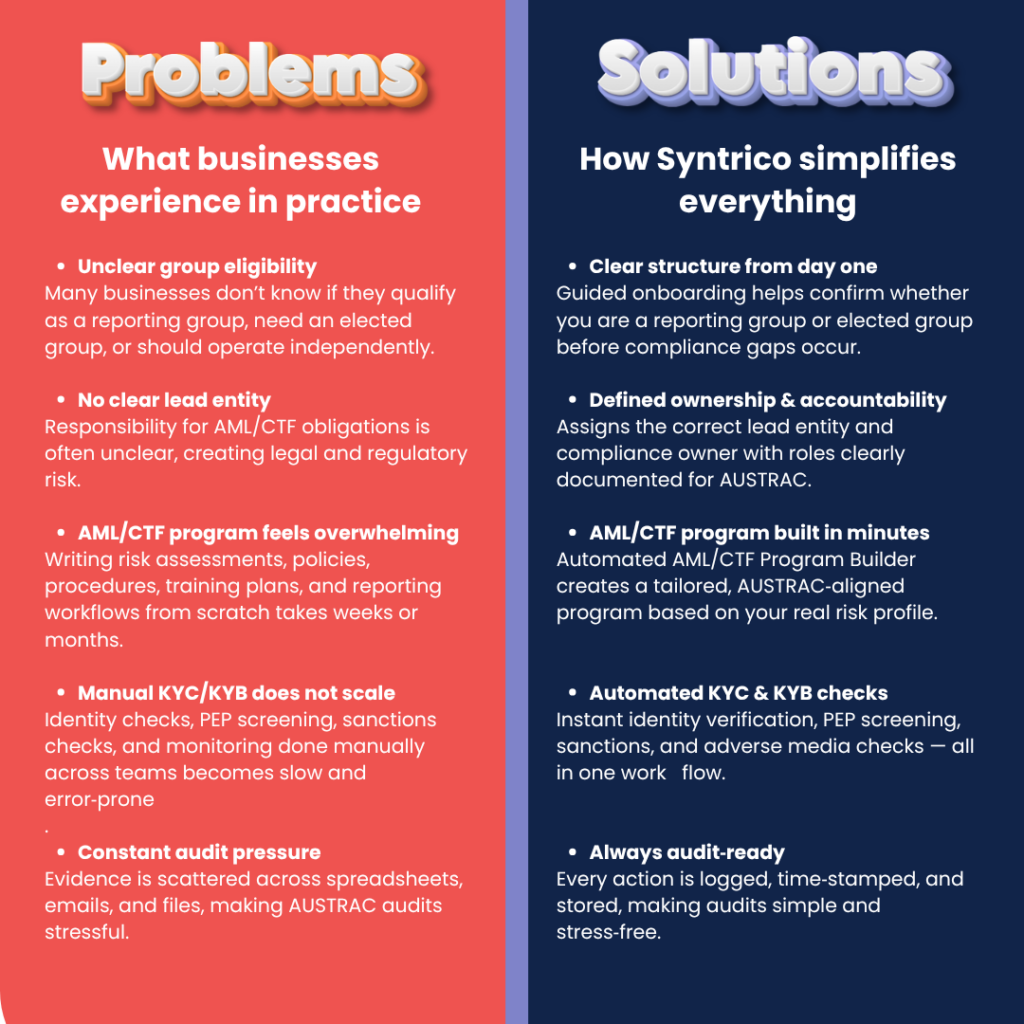
Reporting Groups Are Manageable. Non-Compliance Is Not.
The reporting group framework AUSTRAC introduced is one of the practical tools for Tranche 2. It lets connected businesses share the load, centralise expertise, and avoid building five separate compliance programs where one will do.
But it only works when it is, set up properly. The right structure. The right lead entity. The right written agreement. The right program is behind it.
For most SMEs in law, accounting, real estate, and professional services – the challenge is not understanding the concept. The challenge is executing it without a compliance department, without months of consulting fees, and without taking your focus away from running your business.
This is what Syntrico is about filling the gap.
If you want to get your reporting group sorted, your AML/CTF program built, and your practice genuinely ready before July 2026 – Syntrico’s AML Guardian is worth 20 minutes of your time.
FAQ’s
1: What is a reporting group under AUSTRAC Tranche 2?
A reporting group is when two or more businesses agree to share one AML/CTF compliance program under a nominated lead entity. Instead of every office or entity building its own program separately, they operate under one centralised framework. There are two types: business groups (connected by ownership) and elected groups (voluntarily joined by written agreement).
2. Does my small practice need to form a reporting group?
Not necessarily. If you operate as a single entity with no subsidiaries or affiliated offices, you do not need a reporting group; you manage your own AML/CTF program independently. However, if you operate across multiple related entities, branches, or franchise arrangements, forming a reporting group can significantly reduce duplication and compliance costs.
3. Can Syntrico help with both business groups and elected groups?
Yes. Syntrico’s onboarding process guides you through identifying your structure and assigning the right compliance of ownership, whether you are a business group under common control or an independent practice looking to formalise an elected group arrangement.
4. How long does it take to build an AML/CTF program on Syntrico?
Syntrico’s automated program builder generates a tailored, AUSTRAC-aligned AML/CTF program in under 20 minutes. Manual setups through consultants typically take weeks. The platform uses your risk assessment inputs to build a program specific to your business, not a generic template.
5. Is Syntrico only for large businesses?
No. Syntrico is specifically built for Australian SMEs – the small accounting firms, boutique law practices, independent real estate agencies, and sole-operator conveyancers who make up the bulk of Tranche 2 which is 90,000 new reporting entities. Their pricing and platform design reflect this focus entirely.
6. How do I get started with Syntrico?
Visit syntrico.com.au, sign up for a free 14-day trial, and begin the guided onboarding. No compliance background is needed. The platform walks you through every step, from confirming whether you provide designated services, building your program, to verifying your first client.