
Anti-Money Laundering (AML) and Counter-Terrorism Financing (CTF) regulations are critical for businesses operating in Australia. They help prevent criminals from using financial systems to launder money or finance terrorism. While many organisations understand the importance of AML/CTF compliance, confusion often arises around two key components: the AML/CTF Program and the AML Policy. These terms are sometimes used interchangeably, but they serve different purposes and have distinct requirements under Australian law.
This blog clarifies the difference between an AML/CTF Program and an AML Policy, drawing on guidance from AUSTRAC, Australia’s financial intelligence agency. Understanding these distinctions will help businesses build effective compliance frameworks that meet legal obligations and protect their operations.
What is an AML/CTF Program in Australia?
Under Australia’s AML/CTF Amendment Act 2024, reporting entities are no longer required to separate their program into the old Part A and Part B structure. From 31 March 2026, organisations can structure their AML/CTF Program in any way that meets the requirements of the Act – if it effectively identifies, mitigates and manages money laundering, terrorism financing and proliferation financing risks.
Key Features of an AML/CTF Program:
- Risk Assessment
Organisations must regularly assess their exposure to money laundering, terrorism financing, and proliferation of financing risks. This involves understanding the types of customers, products, services, and geographic locations that pose higher risks. Under the 2024 reforms, AUSTRAC now requires reporting entities to consider proliferation financing – the financing of weapons of mass destruction – as part of their risk assessment, even where that risk is assessed as low.
- Customer Due Diligence (CDD)
The program outlines how to verify customer identities, monitor transactions, and report suspicious activities. This includes procedures for onboarding new customers and ongoing monitoring.
- Transaction Monitoring
Systems and processes are established to detect unusual or suspicious transactions that may indicate illicit activity.
- Reporting Obligations
The program details how to report suspicious matters and threshold transactions to AUSTRAC within required timeframes.
- Training and Awareness
Staff must be trained regularly on AML/CTF obligations, recognising suspicious behaviour, and following internal procedures.
- Independent Review
Under Australia’s updated AML/CTF framework, the program must be independently evaluated at intervals appropriate to the nature, size and complexity of the business. For newly regulated entities coming under AUSTRAC’s scope from 1 July 2026, the deadline for the first independent evaluation is determined by their AUSTRAC account number and will be no less than three years from the commencement date.
Why an AML/CTF Program Matters for Australian Businesses
The AML/CTF Program is the backbone of an organisation’s compliance framework. It translates legal requirements into practical actions and controls tailored to the organisation’s specific risks. Without a robust program, businesses risk regulatory penalties, reputational damage, and exposure to criminal activity.
What is an AML Policy?
An AML Policy is a formal document that sets out an organisation’s commitment to preventing money laundering and terrorism financing. It provides high-level principles and the organisation’s stance on compliance with AML/CTF laws.
Key Elements of an AML Policy:
- Statement of Commitment
The policy declares the organisation’s dedication to complying with AML/CTF laws and maintaining ethical standards.
- Roles and Responsibilities
It defines who within the organisation is responsible for AML/CTF compliance, including governing bodies, senior management, and the mandatory AML/CTF Compliance Officer. From 31 March 2026, reporting entities are legally required to appoint a fit and proper AML/CTF Compliance Officer at a management level, who has sufficient authority, independence, and access to resources to fulfil the role.
- Overview of Legal Obligations
The policy summarises the key AML/CTF requirements that the organisation must follow.
- General Approach to Risk Management
It outlines the organisation’s approach to identifying and managing risks related to money laundering and terrorism financing.
- Employee Expectations
The policy sets expectations for employee conduct, including the obligation to report suspicious activities.
The Role of the AML Policy
The AML Policy acts as a foundation for the AML/CTF Program. It communicates the organisation’s values and compliance culture to employees, customers, and regulators. While it does not detail specific procedures, it guides the development and implementation of the program.
How the AML/CTF Program and AML Policy Work Together.
The AML Policy and AML/CTF Program are complementary parts of a strong compliance framework.
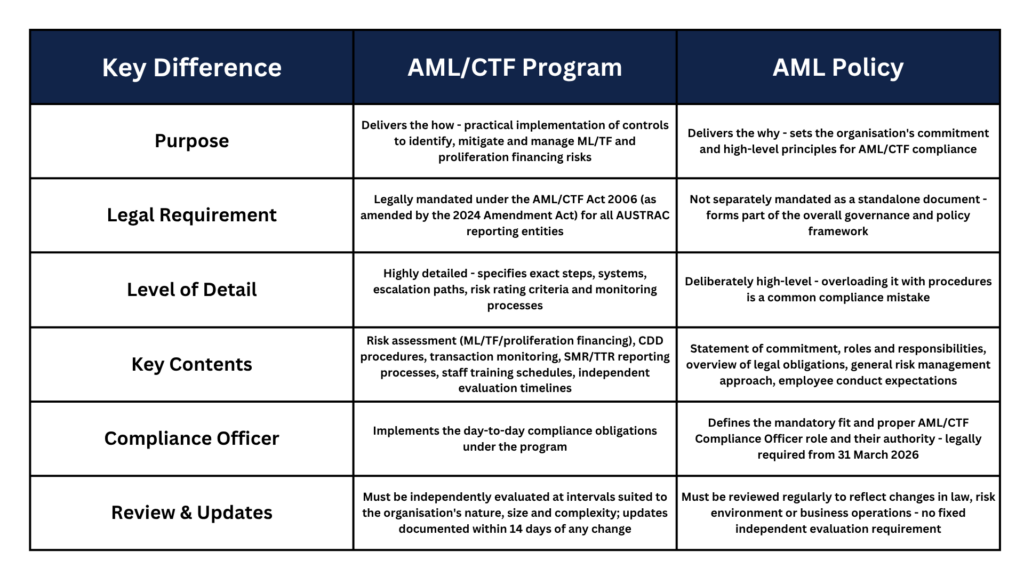
The AML Policy: It explains why the organisation is committed to AML/CTF compliance and what principles guide its approach.
The AML/CTF Program: It explains how the organisation implements controls, monitors risks, and meets its legal obligations.
For example, the policy might state that the organisation will conduct customer due diligence to prevent illicit activity. The program then explains the specific steps, such as verifying identification documents, screening customers against sanctions lists, and monitoring transactions for suspicious patterns.
Key differences between the AML/CTF Program and AML Policy
How to Develop an AML/CTF Program and AML Policy in Australia: Step-by-Step
- Understand Regulatory Requirements
Review AUSTRAC’s guidance and relevant legislation to know what is required.
- Conduct a Risk Assessment
Identify your organisation’s specific money laundering and terrorism financing risks.
- Draft the AML Policy
Write a clear, concise policy that reflects your organisation’s commitment and outlines responsibilities.
- Develop the AML/CTF Program: Create detailed procedures and controls tailored to your risk profile.
- Train Staff: Ensure all employees understand the policy and program and know how to comply with them.
- Monitor and Review: Regularly check the effectiveness of your program and update the policy as needed.
Why Businesses should prioritise both AML/CTF Programs and AML Policies
Failing to implement both a strong AML Policy and a comprehensive AML/CTF Program exposes businesses to serious risks:
- Regulatory penalties: AUSTRAC can impose fines and sanctions for non-compliance.
- Reputational damage: Associations with money laundering or terrorism financing harm trust.
- Operational risks: Ineffective controls can lead to financial losses or legal action.
By clearly distinguishing and properly implementing both components, organisations build resilience and demonstrate their commitment to lawful and ethical operations. The policy sets out the tone and commitment, while the program delivers practical steps to meet legal obligations. Organisations that invest in both create a strong defence against financial crime and protect their reputation and operations.
Understanding the difference between an AML/CTF Program and an AML Policy is step one. Building them correctly – and on time – is what matters most. Syntrico’s AML Guardian is purpose-built for Australian businesses preparing for AUSTRAC’s 2026 reforms. From automated risk assessments to ready-to-submit SMRs, everything you need is in one place.