
The regulated business landscape of today means getting to grips with the nuances between identification vs verification AML is more important than ever. Many businesses wrongly assume that gathering customer data will tick all the boxes on Know Your Customer (KYC) requirements but fail to recognise the fundamental distinction between identification and verification.
If you’re looking to ensure you’re up-to-speed on regulatory standards, mitigate financial crime, and enhance the customer onboarding experience, identifying the difference between identification and verification is a huge leap towards a stronger compliance framework.
What is Identification in AML?
Identification, in an AML context, is the process by which a business collects information about the prospective customer before establishing a business relationship with them. Essentially, identification is how you ascertain exactly who a customer claims to be.
A customer identification program may commonly collect some of the following data
• Full legal name
• Residential address
• Date of birth
• Company registration details
• Contact details
In terms of compliance, this forms the foundation. For businesses engaging in Customer Due Diligence (CDD), without data, no further steps can be taken. The trouble is, by itself, this data might not be authentic.
If identification is about data collection, then verification is about data confirmation. Identity validation in an AML process involves confirming that the customer information you have already received through the identification process is valid, true and accurately represents the customer.
Identity validation in AML could look like:
• Identity document validation via online checks
• Biometric identification methods (like facial recognition)
• Database checks against known lists of sanctioned individuals, Politically Exposed Persons (PEPs), and adverse media sources as required under AUSTRAC obligations
• Registration verification against official records
• Address verification through third-party services
Verification builds trust by confirming that the customer is exactly who they claim to be. This helps organisations identify the fraudsters and higher risk individuals, during the onboarding process.
Why Both Identification and Verification are Legally Important
As demonstrated, both Identification and verification processes have distinct roles that contribute to meeting regulatory obligations regarding Customer Due Diligence (CDD).
You cannot have verification without first identifying your customer and attempting verification without identification would pose a significant compliance risk.
The benefits of identifying and verifying your customer effectively include :
• Compliance with AML requirements
• Mitigating risks of fraud and identity theft
• Enhancement of due diligence practices
• Ensuring ongoing risk assessments are informed
• Increasing audit readiness
An effective compliance system incorporates both of these procedures into one onboarding procedure.
Common AML Onboarding Mistakes
Many businesses stumble over the terminology associated with compliance and, consequently, make simple errors in their processes, leaving them at risk. Some common mistakes that businesses will make are
• Dependence on Information Provided by Customers
Using unverified information in compliance procedures is risky and can make companies susceptible to fraud.
• Insufficient AML Screening
Not performing regular AML screening can lead to high-risk clients, Politically Exposed Persons (PEPs), and sanctioned individuals going unnoticed -both at onboarding and throughout the ongoing client relationship.
• Manual Verification Procedures
Manual identity checks can be a slow process with a higher margin for errors and poor record keeping.
• Insufficient Documentation
A lack of validation documentation can cause problems when reviewing compliance procedures.
Benefits of Using Digital Verification Tools for Compliance
Digital compliance systems make identification and verification more simple through automated identity confirmation processes.
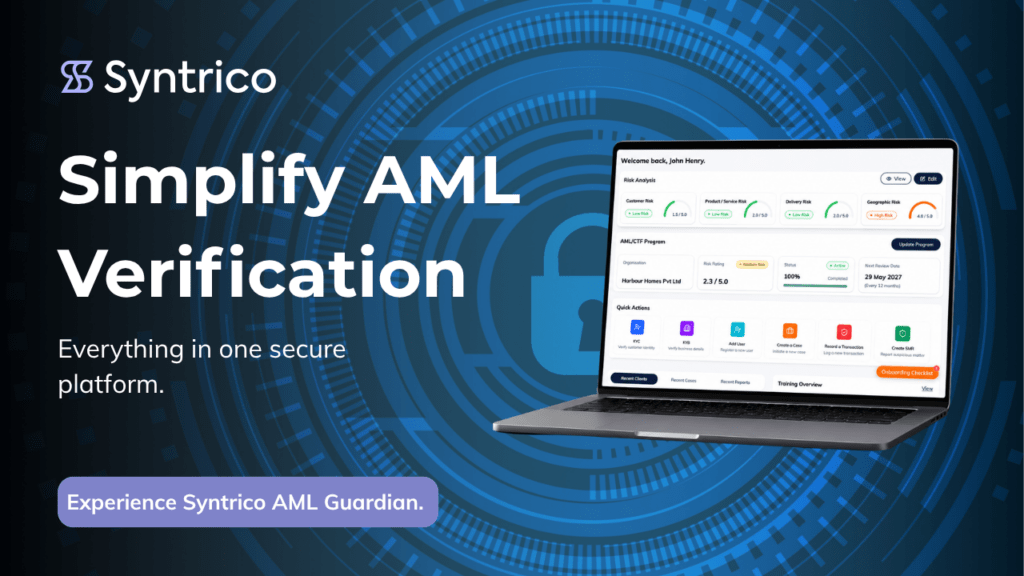
The Syntrico AML Guardian assists organisations in simplifying compliance by including customer identification and verification, AML screening and continuous monitoring in a single platform. This allows the organisation to:
• Perform real-time identity verification
• Perform AML screening checks automatically
• Meet initial and ongoing CDD requirements in line with AUSTRAC obligations
• Keep compliance records
• Cut down on manual onboarding tasks
In this way, the digital process makes compliance easier for the organisation.
A Real-World Compliance Example
Imagine an accounting firm takes on a new commercial client. In order to comply with customer identification requirements, the firm begins by requesting business and director details before running an AML search against existing, high-fidelity records. It also matches each business/director fact against reliable sources.
This is the verification component of customer identification; if the information collected in the identification stage is wrong, that information passes through to the AML process and could go completely unchecked without identity confirmation checks to counter this, in short, the entire anti money laundering compliance process fails without both stages of the KYC process.
In essence this ensures that fraudulent or factually incorrect information does not get through the system and subsequently expose the firm to financial crime risk.
Conclusion
Knowing and correctly implementing the distinctions between identification and verification under anti money laundering regulations is paramount for all of the above. Identifying and then verifying your clients has two purposes, firstly; gathering customer data, secondly; assuring its truth and authenticity. You need both and not one or the other to get to grips with and achieve compliant CDD and effective AML verification processes, using a compliant identity validation service in your business will do you wonders.
By integrating customer identification, customer identity validation, and automated AML checks into an intelligent, digitally integrated compliance system you gain better control of risk, avoid compliance issues and provide efficient customer experience.
Ready to Simplify AML Compliance?
Avoid the compliance risks created by manual processes. Syntrico AML Guardian is a platform to centralise your customer onboarding. Book a personalised demo today!.