
As Australia approaches more stringent AML/CTF compliance standards which will be introduced through Tranche 2, most businesses are making preparations to establish or enhance their AML/CTF compliance systems. If you’re a real estate agent, accountant or law firm-or indeed, any regulated business-you must implement an effective AML program in Australia.
AML/CTF program assists businesses in detecting, alerting, and controlling the likelihood of financial crime, but also in fulfilling AUSTRAC requirements. The main concern for many organisations is not knowing what needs to be incorporated without over-complication.
This guide covers the main components of an effective AML program in Australia, and how businesses can maintain compliance secure in the knowledge that they are doing so.
Why an AML Program Matters in Australia
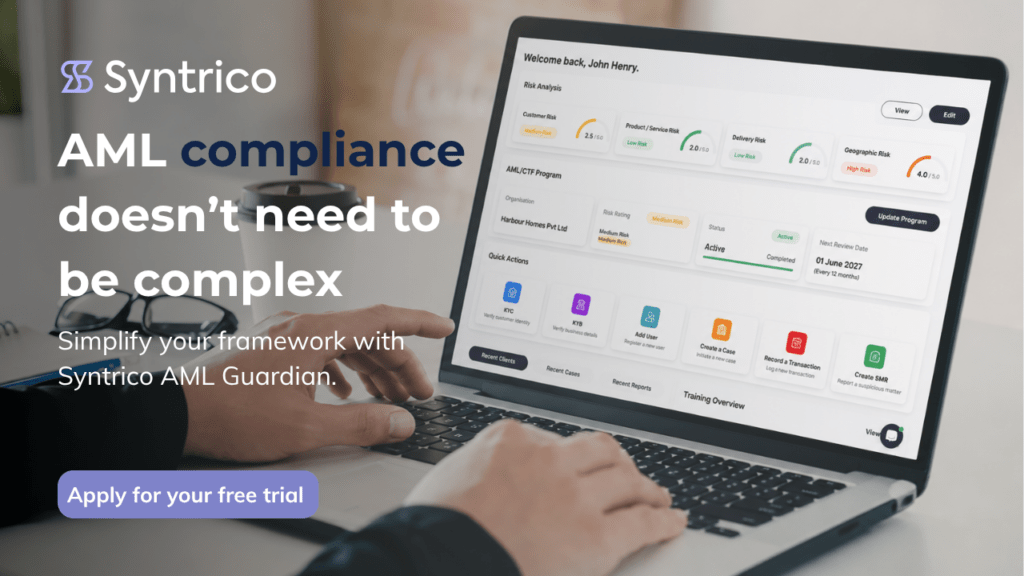
An AML/CTF program is a written document setting out how a business goes about reducing money laundering and terrorism financing risks. AUSTRAC expects all reporting entities to put in place policies, procedures, systems and controls to reduce the potential for financial crime. Syntrico AML Guardian helps businesses manage this process in one place with guided AML setup, risk assessments, customer checks and audit-ready records.
Without a structured program, businesses may struggle with:
- Inconsistent customer checks
- Poor record management
- Missed suspicious activity reporting
- Staff expressed confusion about who was responsible for compliance duties
- Higher risk involvement in an AUSTRAC runs audit
A robust AUSTRAC AML program ensures that a business can operate efficiently while safeguarding its reputation and clients.
Key Components of an AML Program Australia Businesses Need
1. Risk Assessments
Each tranche 2 entities is exposed to AML risk to a greater or lesser degree, depending upon its customers, the services it offers, the jurisdictions in which it operates, the types of transaction it handles, et cetera.
An AML risk assessment should identify:
- High-risk customer categories
- Geographic risk exposure
- Complex transaction patterns
- Products or services that are easy to use so can be misused
This sets the groundwork for your entire AML CTF program requirements process. Syntrico AML Guardian helps document and review business-wide risk assessments so teams can track AML risks clearly and consistently.
Businesses should also carry out or review risk assessments on a regular basis, as the circumstances of the business increase or the legal requirements alter.
2. Customer Due Diligence
Customer due diligence, it is one of the crucial elements of an AML.
Businesses must verify customer identities before providing services. This process may include:
- Individual identity verification
- Business verification (KYB)
- Beneficial ownership checks
- Politically Exposed Person (PEP) screening
- Improved comprehensive Know your customer (KYC) process for customers with increased risks
A robust onboarding process minimizes compliance risk early on, so they are less exposed over time. Syntrico supports KYC, KYB, PEP, sanctions and adverse media checks to make customer onboarding faster and more consistent.
3. Internal Policies and Procedures
AML policies that are well documented help ensure consistency of approach between teams and between departments.
Your internal procedures should clearly explain:
- The way staff approach customer onboarding
- Handling of potential fraud activity
- Record-keeping requirements
- Reporting obligations
- Risk review procedures
- Staff responsibilities
The best documentation is simple and practical, rather than too “techie” that the team ignores it. Syntrico AML Guardian keeps AML policies, procedures and compliance records centralised, making them easier for teams to access and follow.
Ongoing Monitoring and Staff Responsibilities
An AML program should extend beyond onboarding. Firms need to watch customer activity for evidence of suspicious behaviour or advancing risk.
Ongoing monitoring may include:
- Reviewing transaction behaviour
- Updating customer information
- Monitoring high-risk accounts
- Identifying suspicious activities
Staff training also plays a major role in maintaining compliance. Employees should understand:
- AML warning signs
- Reporting responsibilities
- Internal compliance procedures
- How to escalate concerns
Routine training keeps things fresh for a business throughout the organization. Syntrico helps businesses monitor customer risk, update records and maintain staff training logs for better compliance control.
Independent Reviews and Compliance Audits
Independent audits are critical in determining whether an AML program is functioning.
A review should assess:
- Policy effectiveness
- Staff compliance
- Monitoring systems
- Reporting accuracy
- Risk management controls
For businesses preparing for their AUSTRAC audits, it is advisable to do some internal auditing on a regular basis before things escalate into a compliance disaster. Syntrico AML Guardian keeps compliance records, due diligence history and risk assessments audit-ready for internal reviews or AUSTRAC checks.
Technology Tools for AML Management
Manual compliance can quickly become difficult to handle-particularly as a business expands.
Modern AML platforms can help automate:
- KYC and KYB verification
- Risk assessments
- Customer screening
- Ongoing monitoring
- Record management
- Reporting workflows
Syntrico AML Guardian can help make your AML process easier by putting all compliance procedures in one place. Companies wishing to determine what they can expect with future AML responsibilities can consult Tranche 2 Obligations Guide for a practical look at compliance preparation.
Key Takeaway
The path to an efficient AML program which Australian businesses can trust shouldn’t be overly complex. The focus should be on the establishment of transparent procedures, effective risk management, ongoing staff training, and continued monitoring according to AUSTRAC.
When you have a compliance framework in place coupled with the support of appropriate technology, businesses can operate at a lower risk, be more efficient and be better equipped to manage future AML requirements. Ready to simplify AML compliance? Book a personalised demo of Syntrico AML Guardian and see how your business can manage AML/CTF obligations with confidence.