Beneficial ownership TCSP compliance starts with a simple-looking client – a company name, an ABN, a director listed on the incorporation documents. But behind that company there might be shareholders, holding companies, trusts, corporate trustees, and two or three layers of ownership before you reach an actual person.
The entity name tells you who the customer is. It doesn’t tell you who ultimately owns or controls it – and for a TCSP, that second question is often the harder one to answer well.
Can your team clearly trace who really owns or controls that client – and find the evidence quickly when someone asks for it?
The Client entity is only the starting point
Identifying the customer entity is the first step, not the last one. Under AUSTRAC guidance, a beneficial owner is an individual who directly or indirectly owns 25% or more of the customer, or who otherwise controls the customer. Where the immediate owner isn’t an individual – say, another company or a trust – reporting entities need to keep following that chain of ownership until they reach the individual(s) who ultimately own or control the customer.
For a TCSP, that means the compliance picture of a client isn’t complete once you’ve verified the entity. You also need visibility of:
- The individuals who directly or indirectly own or control the entity
- Any intermediate companies or trusts sitting in the ownership chain
- Directors and other people authorised to act on the entity’s behalf
- Trustees, and where the customer is a trust the beneficiaries or classes of beneficiaries the trust is receiving the service on behalf of
Identifying the entity answers “who is the customer.” Tracing ownership answers “who is really behind them.” A TCSP needs both – and needs to be able to demonstrate both.
When Ownership Structures become difficult to follow
Not every client looks the same, and the effort involved in tracing ownership scales with how the structure is built.
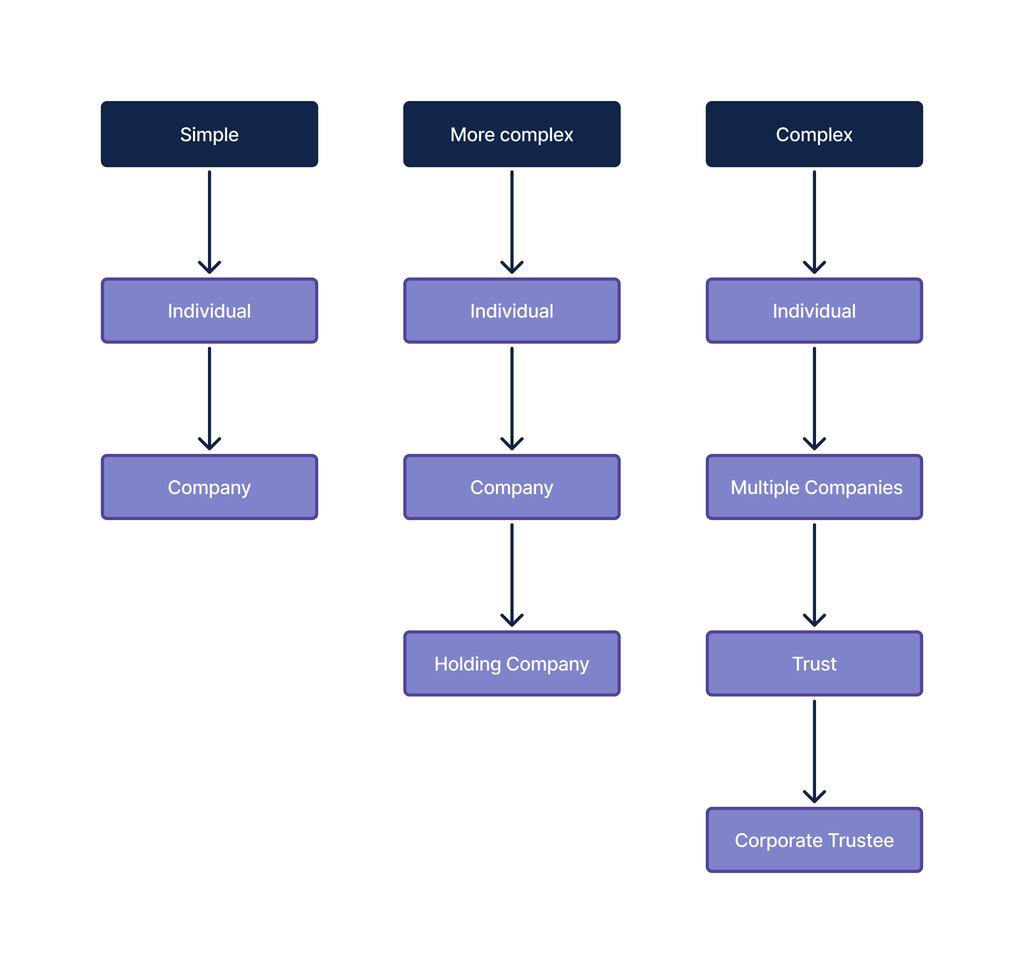
Simple: One person, one entity, one layer to check.
More complex: Now there’s an intermediate entity between the person and the customer, and that intermediate entity needs to be looked through, not just noted.
Complex: Here, tracing ownership means working through several entities, identifying the trustee’s authority to act, identifying the trust’s beneficiaries (or classes of beneficiaries), and still arriving at the individuals who ultimately own or control the arrangement.
If any of these scenario’s sound like a normal Tuesday for your onboarding team, that’s exactly the kind of structure this article is about.
Can your current process answer these questions?
For a TCSP, beneficial ownership means identifying the individual or individuals who ultimately own or control a client entity, even where that ownership sits behind multiple companies or trusts and being able to evidence how that conclusion was reached.
Use this as a self-assessment, not a tutorial. For a moderately complex client, can your team currently:
- Identify the relevant people behind the entity, not just the entity itself?
- Trace ownership through multiple layers without losing the thread?
- Verify the information collected; where is verification required?
- Identify directors, trustees, and other relevant parties acting on the entity’s behalf?
- Keep ownership information connected to the customer’s record, rather than sitting in a separate file?
- Locate the supporting documentation quickly if it’s needed?
- Identify when ownership information needs to be reviewed or updated?
- Rely on a process that’s applied consistently regardless of which staff member handles the file?
- Retrieve the relevant compliance evidence on request, without reconstructing it from memory?
If most of these are confident “yes,” your process is likely holding up well. If a few give you pause, that’s worth looking at before client volume makes the gap bigger.
The problem with managing Beneficial Ownership manually
None of this means a manual process is automatically non-compliant. The issue is that manual processes tend to get harder to manage, maintain and evidence as ownership structures become more layered, and client numbers grow.
Common pain points look like:
- Ownership information split across onboarding forms, spreadsheets and email attachments
- Company extracts and trust deeds saved in folders disconnected from the client’s compliance record
- The same ownership documents requested more than once because nobody’s sure what’s already on file
- Data entered manually in more than one place, increasing the chance of inconsistency
- Ownership information going stale because there’s no clear trigger to review it
- Limited visibility for management into which clients have fully traced, verified ownership and which don’t
- Time-consuming manual reviews when a client’s structure needs to be revisited
These aren’t regulatory breaches by themselves. But they make it harder to do the two things that matter most: tracing ownership accurately, and being able to show your work later.
How can TCSPs manage Beneficial Ownership information more effectively?
TCSPs can manage beneficial ownership more effectively by connecting the process into clear stages – identifying relevant parties, verifying them where required, linking that information to the client record, assessing risk, keeping records, and reviewing when circumstances change – rather than treating each step as a separate manual task.
Identify → Verify → Connect → Assess → Record → Review
- Identify the relevant individuals and entities in the ownership chain
- Verify the information collected, where verification is required for the customer type and designated service
- Connect ownership information directly to the client’s compliance record, not a standalone file
- Assess how the ownership structure and relevant parties factor into the client’s risk rating
- Record the evidence – documents, verification steps, decisions – in a retrievable form
- Review the ownership picture when circumstances change, not only at a fixed renewal date
This isn’t about collecting more information for its own sake. It’s about making the information you already collect usable across the rest of your compliance process.
Beneficial Ownership doesn’t sit in isolation
Beneficial ownership isn’t a standalone task – it’s one link in a longer chain that runs through the whole client relationship:
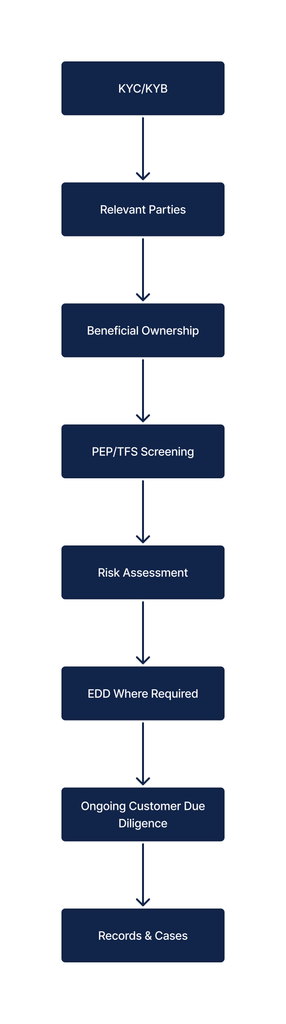
Once you’ve identified the entity (KYC/KYB) and the relevant parties connected to it, beneficial ownership tells you who to focus your due diligence on. Those individuals then need to be screened against PEP and sanctions data where applicable, factored into the client’s risk assessment, subject to enhanced due diligence if the structure or risk profile calls for it, and kept current through ongoing customer due diligence as circumstances change over the life of the relationship.
When beneficial ownership is disconnected from these other stages – sitting in its own spreadsheet rather than linked to screening and risk data – the whole chain becomes harder to maintain. A change in ownership that isn’t reflected in screening, or risk assessment is a gap in the process, even if the original ownership check was done correctly.
Where AML Compliance software can help TCSPs
Bringing these stages into one system changes what’s operationally realistic for a TCSP handling growing volumes of layered client structures. A centralised approach can help:
- Keep entity information, relevant parties and beneficial ownership data connected in one client record
- Link screening results directly to the individuals they concern, including beneficial owners identified through a chain of ownership
- Apply risk assessment consistently, factoring in ownership complexity as a risk input
- Trigger enhanced due diligence workflows where the structure or risk rating calls for it
- Keep supporting documents – company extracts, trust deeds, verification evidence – attached to the relevant client record
- Manage cases or escalations that arise from unclear or unusual ownership structures
- Support ongoing monitoring so ownership information doesn’t go stale between reviews
This kind of software supports the compliance process – it doesn’t replace the judgement of your compliance officer or remove the firm’s regulatory responsibility for the conclusions reached.
AML Guardian: Bring your Client’s Ownership picture into one workflow
Syntrico’s AML Guardian is an AUSTRAC-aligned AML/CTF compliance platform built for Australian Tranche 2 reporting entities, including TCSPs managing company formation, registered office and nominee director/trustee relationships.
For beneficial ownership specifically, AML Guardian helps TCSPs:
- KYC/KYB – organise customer and entity information as the starting point for the ownership picture
- Beneficial ownership – manage information on relevant ownership and control, including through layered structures, within the client’s compliance record
- Screening – connect relevant parties, including identified beneficial owners, to PEP and sanctions/adverse media screening where applicable
- Risk assessment – factor customer and ownership information into the broader risk assessment workflow
- Enhanced due diligence – support EDD workflows where a client or structure requires additional scrutiny
- Documents – keep ownership and verification documentation connected to the client record rather than stored separately
- Cases – manage issues that need further review or investigation, including unclear ownership structures
- Ongoing monitoring – support the continued management of ownership and risk information after onboarding, not just at the start of the relationship
AML Guardian supports how a TCSP manages, centralises and evidences this workflow. It doesn’t replace the firm’s regulatory responsibility, and it isn’t a substitute for independent legal advice on how AUSTRAC’s requirements apply to your specific circumstances.
Fragmented Process vs Centralised Ownership Workflow
| Fragmented/Manual Approach | Centralised AML Workflow |
|---|---|
| Ownership information in spreadsheets | Centralised customer information |
| Documents across email/folders | Documents connected to the workflow |
| Manual tracking of ownership chains | Structured compliance process |
| Difficult to follow ownership layers | Clearer visibility of relevant parties |
| Separate screening records | Connected screening workflow |
| Manual risk tracking | Centralised risk workflow |
| Difficult evidence retrieval | Easier access to compliance records |
Can your TCSP clearly trace every Client Relationship?
The goal isn’t simply to collect more ownership information. It’s to make that information usable – connected to screening, connected to risk, connected to the evidence you’ll need if AUSTRAC ever asks how you reached a conclusion.
As client structures get more layered and client numbers grow, that connection is exactly what a manual process struggles to hold together. A centralised workflow is what makes it manageable at scale.
See how AML Guardian can help you manage KYC, KYB, beneficial ownership, screening and risk in one compliance workflow.