
The obligations are real, the penalties are serious, and the reputational stakes couldn’t be higher. Here’s everything Australian practices need to know about CDD – and how to do it well.
Every year, Australian regulators issue hundreds of millions of dollars in penalties to businesses that failed to properly verify who they were dealing with. Some of these businesses didn’t set out to break the law – they simply didn’t have the right processes in place. That’s the quiet danger of customer due diligence (CDD): it looks administrative on paper, but the consequences of getting it wrong are anything but minor.
Whether you run an accounting firm, a mortgage broking practice, a legal practice, or a financial services business, understanding your CDD obligations isn’t optional. It’s a legal requirement, a risk management tool, and increasingly, a mark of professional credibility. This guide explains what CDD means in an Australian context, what it requires in practice, and how forward-thinking businesses are modernising the process.
What is Customer Due Diligence?
Customer due diligence is the process of identifying and verifying your customers, understanding the nature of the business relationship, and assessing the potential risk that the relationship poses for financial crime -including money laundering and terrorism financing.
In Australia, CDD obligations are primarily governed by the Anti-Money Laundering and Counter-Terrorism Financing Act 2006 (AML/CTF Act) and the associated AML/CTF Rules. The financial intelligence regulator AUSTRAC oversees compliance and has the authority to investigate and prosecute non-compliant businesses.
At its core, CDD answers three fundamental questions about each customer:
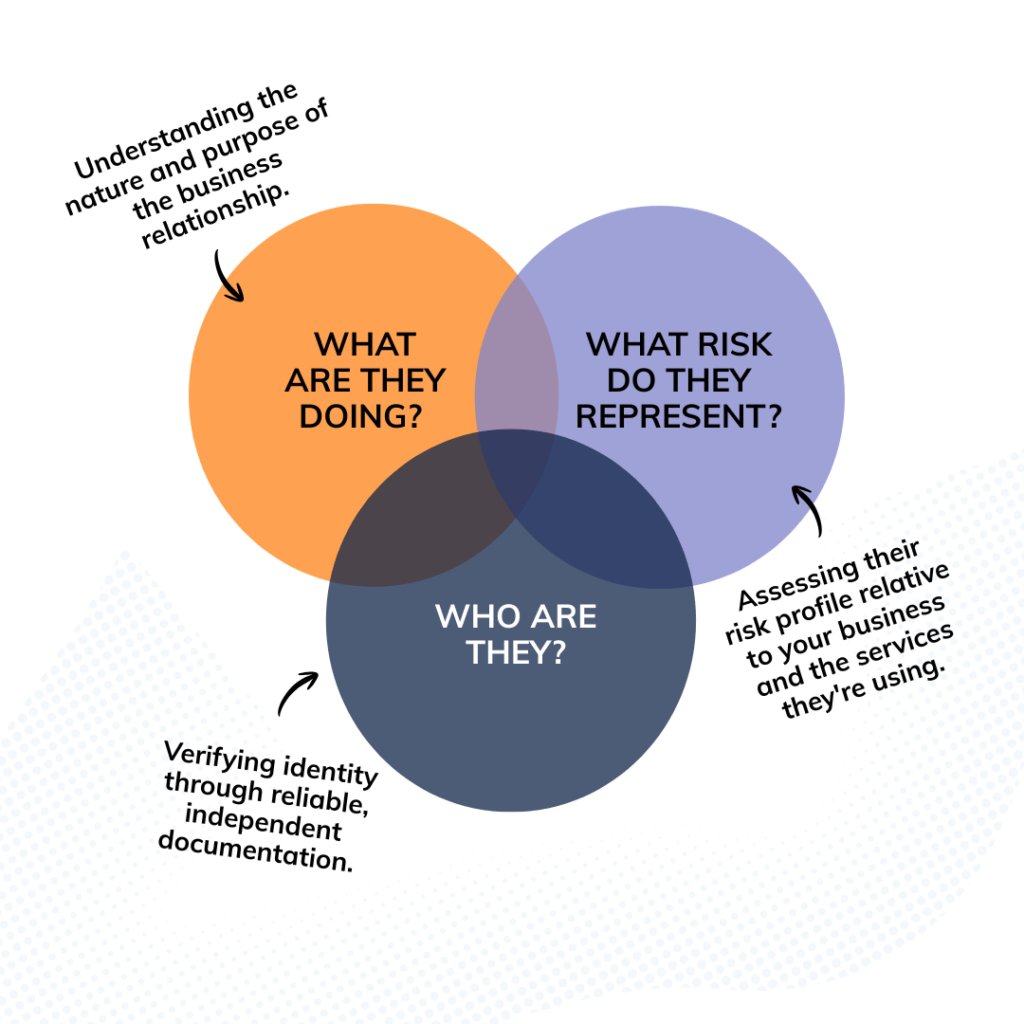
It’s worth clarifying the relationship between CDD and KYC (Know Your Customer). KYC is the broader philosophy – the commitment to understanding with whom you’re doing business/. CDD is the structured, documented process that puts KYC into practice.
The Australian Legal Framework for CDD
Australia’s AML/CTF regime applies to businesses classified as reporting entities – those that provide designated services listed in the AML/CTF Act. This includes banks and financial institutions, remittance service providers, digital currency exchanges, accountants, solicitors, conveyancers, real estate agents, and increasingly, professional service providers following the 2022–2024 AML/CTF reforms.
Australia’s framework closely aligns with the Financial Action Task Force (FATF) Recommendations, the global standard for combating money laundering and terrorism financing. FATF’s Recommendations require member countries to implement a risk-based approach to CDD – meaning that the depth of verification and ongoing monitoring should be proportionate to the risk each customer presents.
The Three Levels of CDD: Simplified, Standard, and Enhanced
Not every customer requires the same level of scrutiny. Australian CDD obligations are structured around a risk-based approach, with three tiers of due diligence.
1. Simplified Due Diligence (SDD)
Simplified due diligence may apply where the risk of money laundering or terrorism financing is demonstrably low. This might include customers who are themselves regulated entities (such as listed companies or government bodies), or products with inherent risk controls such as low-value accounts with strict withdrawal limits.
Important: SDD is not an excuse to skip verification entirely. You still need to document the rationale for applying reduced measures and maintain records.
2. Standard CDD
Standard CDD applies to the majority of customer relationships. It requires:
- Collecting and verifying the customer’s full legal name, date of birth (for individuals), and address.
- Verifying identity against a reliable, independent source — typically a government-issued document such as a passport or driver’s licence.
- Identifying and verifying beneficial owners (those with ultimate control or ownership) for companies and trusts.
- Understanding the nature and intended purpose of the business relationship.
- Conduct ongoing monitoring of the relationship and transactions.
3. Enhanced Due Diligence (EDD)
Enhanced due diligence is required when the risk profile of a customer or transaction is elevated. Triggers for EDD include:
The customer is a Politically Exposed Person (PEP) – a current or former senior government official, or their close associates and family members.
- The customer is from, or the transaction involves, a country assessed as high-risk by FATF or AUSTRAC.
- The customer’s transaction behaviour is unusual or inconsistent with the stated purpose of the relationship.
- There are complex ownership structures that obscure beneficial ownership.
- The relationship was established without face-to-face contact and cannot be verified through standard means.
EDD requires additional steps: gathering more detailed background information, applying additional scrutiny to the source of funds or wealth, and often involving senior management in the approval of the relationship.
Why CDD matters beyond Compliance.
It’s easy to frame CDD purely as a regulatory burden. But that framing misses the bigger picture. Effective customer due diligence protects your practice in ways that go well beyond avoiding AUSTRAC penalties.
Financial Crime Prevention.
Australia loses an estimated $10 billion or more annually to financial crime, including money laundering. Businesses that don’t have robust CDD processes can unwittingly become conduits for illicit funds – and if regulators later find that your practice was used to facilitate crime, the reputational and legal consequences can be catastrophic.
Reputational Protection
In professional services, reputation is everything. Being publicly named in a regulatory action – even without criminal findings, can cost you clients, staff, and partnerships. Strong CDD is a reputational shield.
Better Client Relationships
A well-designed CDD process is also a strong client onboarding experience. When your verification process is efficient, professional, and clearly explained, it builds client confidence. Conversely, a clunky, paper-heavy process sends a poor first impression.
Business Intelligence
The data you collect through CDD – about who your clients are, what they do, how they transact – is genuinely valuable for business intelligence. Firms that treat onboarding as a strategic touchpoint gain a richer understanding of their client base and can tailor services accordingly.
Common CDD challenges Australian practices face
Despite the clear obligations, many Australian businesses struggle with CDD execution. Here are the most common challenges we see across professional services.
- Inconsistent Processes
When CDD is managed manually across spreadsheets, email chains, and individual judgements, standards vary between staff members. One employee might accept a scanned licence; another might require certified copies. Inconsistency creates compliance gaps and audit risk.
- Difficulty Identifying Beneficial Owners
Trusts, complex corporate structures, and nominee arrangements make it genuinely difficult to identify who ultimately controls a business. This is one of the most common failure points in CDD reviews — and a known technique used by those seeking to conceal illicit funds.
- Ongoing Monitoring Falling Behind
Many businesses do a solid job of onboarding CDD but neglect the ongoing monitoring obligation. Customer circumstances change – PEP status, ownership structure, financial behavior. If your CDD is a once-and-done exercise, you’re exposed.
- Poor Record-Keeping
AUSTRAC and other regulators expect you to maintain CDD records for a minimum of seven years. Businesses that store records across multiple unsecured systems – or fail to document the rationale behind their risk decisions – regularly fail audits on record-keeping grounds alone.
- Keeping Up with Regulatory Change
Australia’s AML/CTF regime is evolving rapidly. The Tranche 2 reforms, AUSTRAC guidance updates, and international FATF revisions mean that what was compliant two years ago may not meet today’s standard. Staying current requires active attention – or a partner who does it for you.
CDD Best Practices for Australian Professionals
Building a CDD program that works – and keeps working under scrutiny, requires more than ticking regulatory boxes. Here’s what best practice looks like in 2025.
- Adopt a Risk-Based Approach from Day One
Segment your customer base at risk. Not every client warrants the same level of scrutiny and over-applying EDD wastes resources and creates friction. Develop a clear, documented risk-rating methodology and apply it consistently.
- Verify Identity from Independent, Reliable Sources
Accepting a scanned copy of a document someone emailed you is not verification. Use electronic identity verification (eIDV) services that cross-reference government databases or conduct face-to-face verification where required. For remote onboarding, the Document Verification Service (DVS) is the Australian standard.
- Document Your Rationale
Every risk decision should be recorded. Why did you apply simplified due diligence? Why did this customer qualify for EDD? Why did you choose to continue a relationship despite an elevated risk flag? The regulator doesn’t just want to see what you did — they want to understand why.
- Train Your Team Regularly
CDD is only as strong as the people executing it. Annual AML/CTF training is required for reporting entities – but the best practices don’t stop at the annual box-tick. Create a culture where staff understand the “why” behind CDD, not just the “what.”
- Automate Where You Can
Manual CDD processes are slow, prone to error, and difficult to audit. Compliance platforms that automate document collection, risk scoring, sanctions screening, and record-keeping dramatically improve both efficiency and reliability.
The Future of CDD: What’s Coming for Australian Practices
Customer due diligence isn’t getting simpler – but it is getting smarter. Here are the key trends shaping CDD for Australian professionals.
- Tranche 2 AML/CTF Reform
The 2024 AML/CTF reforms represent the biggest change to Australia’s compliance landscape in nearly two decades. Legal professionals, accountants, and real estate agents now face CDD obligations that previously applied only to financial institutions. The transition period gives affected businesses time to build a program, but that window is closing.
- Digital Identity Verification
The Australian Government’s digital identity framework (including myGovID and the Trusted Digital Identity Framework) is progressively enabling more streamlined, government-backed identity verification. Businesses that integrate with these systems early will have a significant compliance and experience advantage.
- Risk Scoring
Risk scoring has become an essential component of modern CDD, giving businesses a structured and defensible way to assess the level of risk each customer presents before and during a business relationship.
- Perpetual KYC
The industry is shifting from periodic CDD reviews to perpetual KYC – continuous, event-driven monitoring that flags changes in a customer’s profile in real time rather than waiting for an annual review cycle. This approach is more effective, more defensible, and increasingly expected by regulators.
How Syntrico Can Help Your Practice with CDD
Building a compliant CDD program from scratch is time-consuming and technically complex – particularly for professional service firms navigating new obligations under the Tranche 2 reforms. That’s exactly the problem Syntrico was built to solve.
Syntrico is an Australian compliance and workflow automation platform designed for professional services businesses. Rather than cobbling together spreadsheets, email trails, and PDF forms, Syntrico gives practices a single, structured environment to manage the entire customer onboarding and due diligence lifecycle.
- Digital Identity Verification
Integrate with Australia’s Document Verification Service (DVS) to verify passports, licences, residence permits, ID cards with no manual checks required.
- Risk Scoring & Classification
Automatically rate customers as low, medium, high or critical risk based on the screening results and risk assessment checks conducted during the onboarding and due diligence process.
- Automated Ongoing Monitoring
Schedule periodic ODD reviews at defined intervals, and Syntrico automatically prompts your team when one falls due – so no client relationship is ever overlooked.
- Audit-Ready Record Keeping
All CDD records – including the rationale for each risk decision, are stored securely and retrievable for AUSTRAC inspection, meeting the 7-year minimum retention requirement.
- Workflow Automation
Build structured onboarding workflows that guide staff through every CDD step, reducing errors and ensuring no requirement is missed regardless of who handles the client.
- Sanctions & PEP Screening
Screen new and existing clients against international sanctions lists, PEP databases, and adverse media – automatically, onboarding and on an ongoing basis.
For practices facing new AML/CTF obligations under the Tranche 2 reforms, Syntrico offers a structured implementation pathway – from building your initial risk assessment to deploying day-to-day CDD workflows. The result is a CDD programme that’s efficient for staff, seamless for clients, and fully defensible under regulatory scrutiny.
Final Thoughts: CDD is a Business Asset, Not just a Box to Tick
Customer due diligence has evolved well beyond its origins as a banking compliance requirement. Today, it sits at the heart of responsible business practice for any professional firm that deals with clients, manages money, or advises on significant transactions.
The Australian regulatory environment is tightening. The Tranche 2 reforms are real, the AUSTRAC enforcement record is clear, and the reputational consequences of a compliance failure are severe. But the businesses that approach CDD thoughtfully – with well-designed processes, appropriate technology, and a genuine risk culture – don’t just avoid penalties. They build better practices.
They onboard clients faster. They understand their risk of exposure more clearly. They earn client trust through professionalism. And when the regulator comes calling, they’re ready.
🚀 Ready to Modernise Your CDD Process?
Book a free Syntrico demo and see how automated CDD transforms your client onboarding – cutting manual effort, reducing compliance risk, and building the audit trail your practice needs.