
KYC and KYB for real estate agencies under AUSTRAC are essential compliance obligations starting from 1 July 2026. Real estate agencies face increasing scrutiny under Australia’s AML/CTF laws, and understanding these processes is critical for protecting your business from financial crime risks.
This blog breaks down KYC and KYB in simple terms, tailored specifically for real estate agencies. It explains what these processes involve, why they matter, and how to implement them productively under AUSTRAC updated AML/CTF framework.
What KYC means for Real Estate Agencies under AUSTRAC
KYC stands for Know Your Customer. It is the process of verifying the identity of clients to ensure they are who they claim to be. For real estate agencies, this means confirming the identity of buyers, sellers, tenants, and other parties involved in property transactions.
Why KYC matters
Money laundering and terrorism financing often involve real estate because property transactions can move large sums of money and obscure the source of funds. AUSTRAC requires real estate agencies to conduct KYC checks to:
- Prevent criminals from using property deals to launder money
- Detect suspicious transactions early
- Comply with legal obligations and avoid penalties
Key KYC Steps for Real Estate Agencies
1. Identify the customer
Collect official identification documents such as passports, driver’s licenses, or government-issued IDs.
2. Verify the identity
Use reliable methods to confirm that the documents are genuine and belong to the customer. This can include face-to-face checks or digital verification tools.
3. Client Risk Screening
Screen the individual against Australian and international sanctions lists and check whether they are a Politically Exposed Person (PEP). PEPs and sanctioned individuals require Enhanced Due Diligence before the transaction can proceed.
4. Understand the customer’s purpose
Ask about the source of funds and the nature of the transaction to assess risk.
5. Records & Ongoing monitoring
Keep records updated and monitor transactions for unusual activity.
Example: A real estate agent meets a new buyer interested in purchasing a property. The agent requests the buyer’s passport and proof of address, verifies these documents using an online verification service, and records the buyer’s source of funds. This process helps the agency comply with KYC requirements and reduces the risk of unknowingly facilitating illegal activity.
KYC under AUSTRAC is divided into two stages:
Initial CDD – completed before providing any service – and Ongoing CDD, which requires continuous monitoring and updating of customer records throughout the relationship. High-risk clients require Enhanced Due Diligence (EDD).
What KYB means for Real Estate Agencies under AUSTRAC
KYB stands for Know Your Business. It involves verifying the identity and legitimacy of business clients or entities involved in property transactions. This is crucial when dealing with companies, trusts, or partnerships by buying or selling property.
Why KYB is important
Businesses can be used to hide the true owners behind property deals, making it easier to launder money or finance terrorism. AUSTRAC Tranche 2 reforms emphasise the need for real estate agencies to:
- Identify the beneficial owners of business clients
- Understand the structure and control of these entities
- Verify the legitimacy of the business and its activities
Key KYB Steps for Real Estate Agencies
- Identify the business
Obtain official business registration documents, such as an Australian Business Number (ABN) or an Australian company Number (ACN).
- Identify beneficial owners
Determine who ultimately owns or controls the business. This may include shareholders, partners, or trustees.
- Verify business details
Determine who ultimately owns or controls the business. Under AUSTRAC’s rules, a beneficial owner is any individual who directly or indirectly owns or controls 25% or more of the entity. This applies to shareholders, partners, trustees, and any person with significant control over the entity’s decisions.
Confirm that the business is registered and active through ASIC and government databases. Additionally, screen the business and its beneficial owners against Australian and international sanctions lists before proceeding with the transaction.
- Entity and Owner Risk Screening
Screen the business and its owners – Check the business and all identified beneficial owners against sanctions lists and PEP databases before proceeding with the transaction.
- Understand business activities
Assess the nature of the business and its involvement in the property transaction.
- Ongoing monitoring
Keep business information up to date and watch for changes in ownership or control.
Example: A real estate agency is working with a company purchasing commercial property. The agency requests the company’s registration documents, identifies the directors and shareholders, and verifies this information through the Australian Securities and Investments Commission (ASIC). This helps the agency meet KYB requirements and ensures transparency in the transaction.
AUSTRAC AML/CTF Tranche 2 and its Impact on Real Estate Agencies
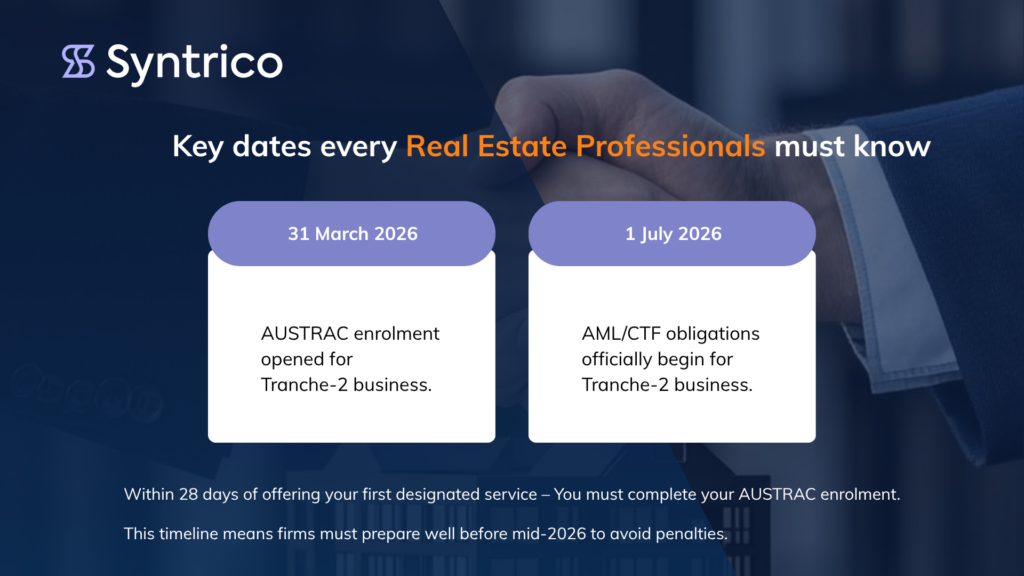
AUSTRAC’s Tranche 2 reforms expand AML/CTF obligations to all real estate agencies involved in property transactions – regardless of the property’s value. There is no minimum price threshold. If you are part of a sale, purchase, or transfer of real property, you are in scope. These reforms require agencies to:
- Conduct enhanced customer due diligence (KYC and KYB)
- Report suspicious matters to AUSTRAC
- Maintain detailed records of transactions and client information
- Implement risk-based approaches to compliance
- Submit an Annual AML/CTF Compliance Report to AUSTRAC confirming that your compliance program has been reviewed and remains effective
What Real Estate Agencies need to do
- Update compliance programs to include new KYC and KYB procedures
- Train staff on identifying and managing AML/CTF risks
- Use technology to streamline identity verification and record-keeping
- Conduct regular audits to ensure ongoing compliance
Common KYC KYB Challenges for Real Estate Agencies under AUSTRAC
Challenge 1: Identifying Beneficial Owners
Many business structures are complex, making it hard to find true owners. Agencies should:
- Request detailed ownership information upfront
- Use ASIC and other databases to verify ownership
- Seek legal advice if ownership is unclear
Challenge 2: Managing Large Volumes of Data
Handling many clients and transactions can overwhelm manual processes. Solutions include:
- Implementing compliance software tailored for real estate
- Automating document collection and verification
- Training staff to recognize red flags efficiently
Challenge 3: Keeping Up with Regulatory Changes
AML/CTF laws evolve regularly. Agencies should:
- Subscribe to AUSTRAC updates and industry newsletters
- Attend compliance workshops and training sessions
- Review and update policies annually
The Benefits of Strong KYC and KYB Practices:
Beyond legal compliance, effective KYC and KYB processes help real estate agencies:
- Build trust with clients and partners
- Protect their reputation from association with financial crime
- Reduce the risk of financial loss and penalties
- Improve operational efficiency through clear procedures
Understanding and applying KYC and KYB requirements under AUSTRAC AML/CTF Tranche 2 is no longer optional for real estate agencies. These processes safeguard the industry and contribute to a transparent property market. Agencies that invest in robust customer and business verification systems will not only comply with the law but also strengthen their business resilience.
Start by reviewing your current compliance program today. Identify gaps in your KYC and KYB processes and take steps to address them. This proactive approach will help your agency navigate regulatory demands confidently and protect your clients and your business from financial crime risks
Make compliance simpler with Syntrico
Managing KYC, KYB, and AML compliance manually is time-consuming and carries real risk. That is where Syntrico comes in.
Syntrico is a purpose-built end-to-end AML compliance platform designed specifically for real estate agencies and other businesses coming under AUSTRAC’s Tranche-2 obligations. It brings your client verification, risk assessments, transaction monitoring, and AUSTRAC reporting into one simple, easy-to-use platform – so your team can focus on growing your business rather than chasing paperwork.
Whether you are just starting your compliance journey or looking to replace a fragmented process, Syntrico gives you everything you need in one place.
Ready to get started?
Book a free demo and see how Syntrico works for your agency – or view pricing to find the right plan for your team. If you want to explore the platform first, get started for free and experience compliance, make it simple.