
CDD does not end when the ID check passes.
For real estate agents and buyer's agents, onboarding is only the start. You need to identify and assess customers, complete the required CDD, capture the other party to the property transaction, monitor transactions and behaviour, respond to red flags, and retain evidence of the decisions you make.
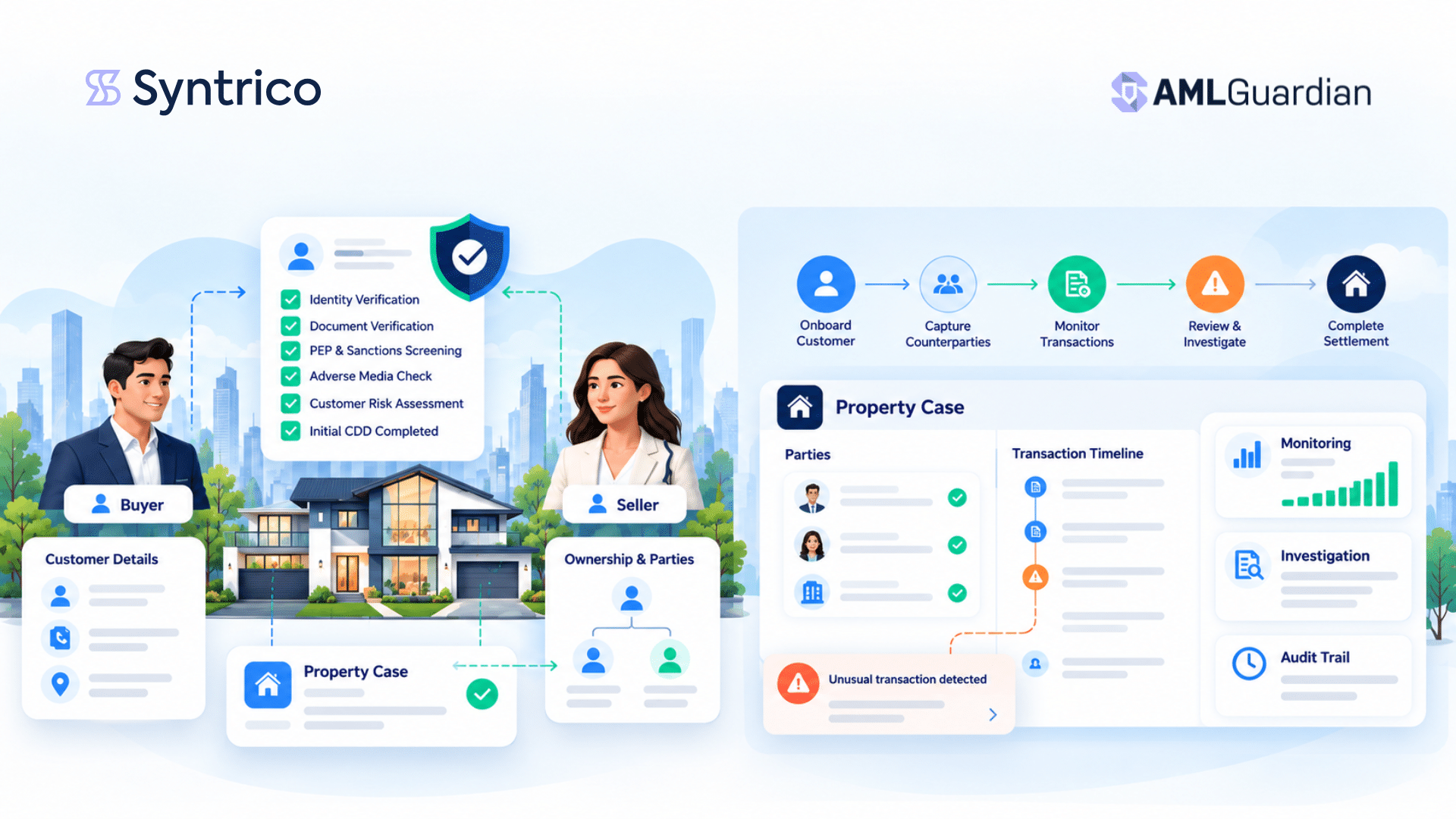
AML Guardian brings identity verification, AML screening, Initial CDD, counterparty management, property case management and ongoing monitoring into one connected workflow.
What AUSTRAC expects across the customer lifecycle
Customer Due Diligence is not a one-off identity check. It starts before or at onboarding and continues while you provide the designated service. Your AML/CTF Program should explain how you identify customers, assess risk, apply the right controls and monitor for changes or unusual activity.
Identify the customer
Determine whether you are dealing with an individual, sole trader, company, trust, partnership or another type of entity, and identify relevant persons, beneficial owners or representatives where required.
Collect & verify information
Collect the KYC information required for the customer type and verify it on reasonable grounds using reliable and independent data or documents appropriate to the customer's risk.
Understand the transaction
Understand the service sought, the nature and purpose of the relationship or transaction, payment or funding information where relevant, and any indicators that increase ML/TF risk.
Screen & assess risk
Consider PEP and targeted financial sanctions requirements together with geographic, customer, service and behavioural risk factors. Apply additional screening or enquiries where appropriate.
Decide & document
Decide whether to proceed, apply additional controls, conduct Enhanced CDD, escalate, report or not provide the service. Keep evidence of the decision and why it was made.
Monitor until the relationship ends
Continue monitoring transactions and behaviour, respond to new triggers, update customer risk and KYC information where appropriate, and keep the required records when the business relationship ends.
Identity verification is important. It is not the whole CDD decision.
Passing an identity check helps establish that a person is who they claim to be. Initial CDD goes further: the reporting entity needs to understand the customer, the service, the relevant people or ownership structure, and the ML/TF risk before deciding how to proceed.
One connected workflow for Initial CDD
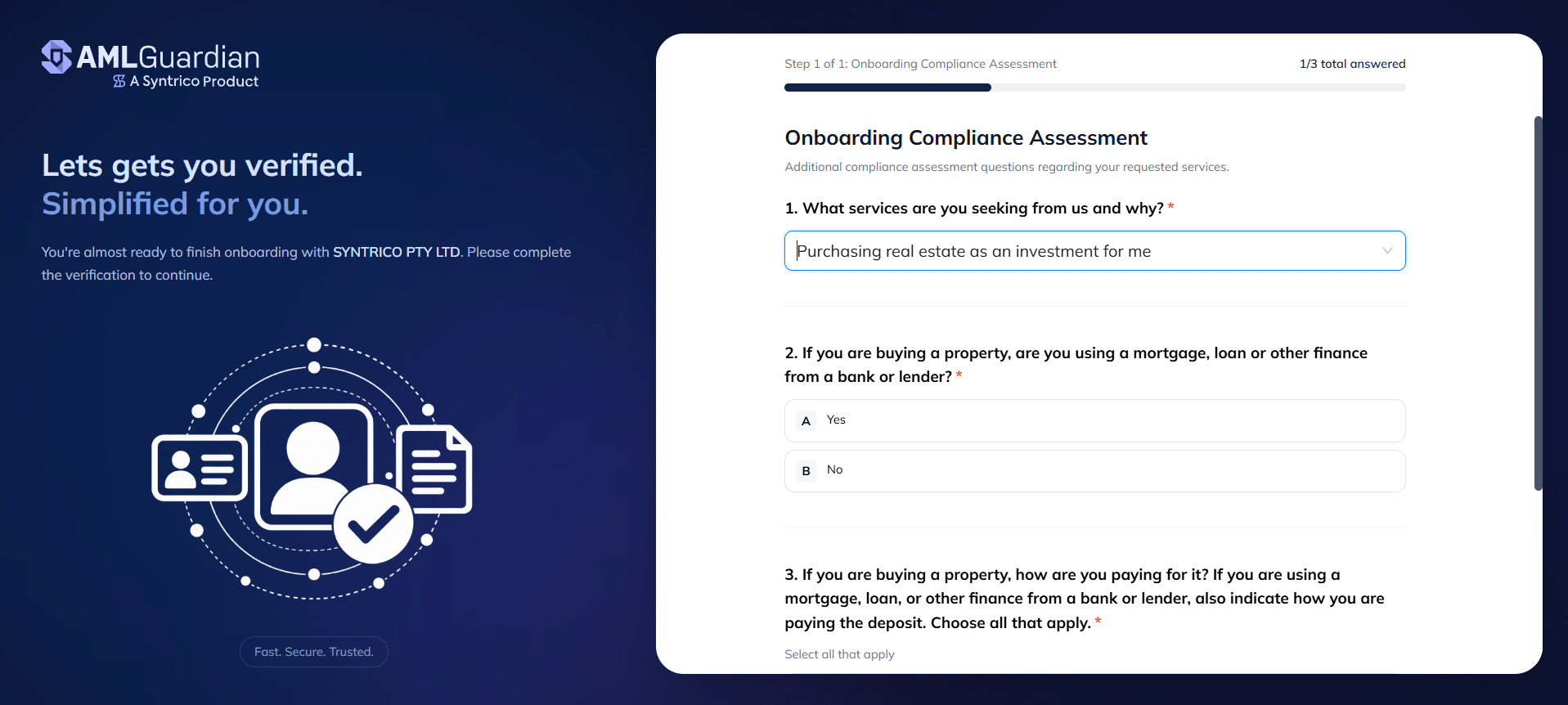
AML Guardian is designed to bring the information and checks needed for an Initial CDD decision into the same customer record, rather than leaving them across separate providers, forms, spreadsheets and inboxes.
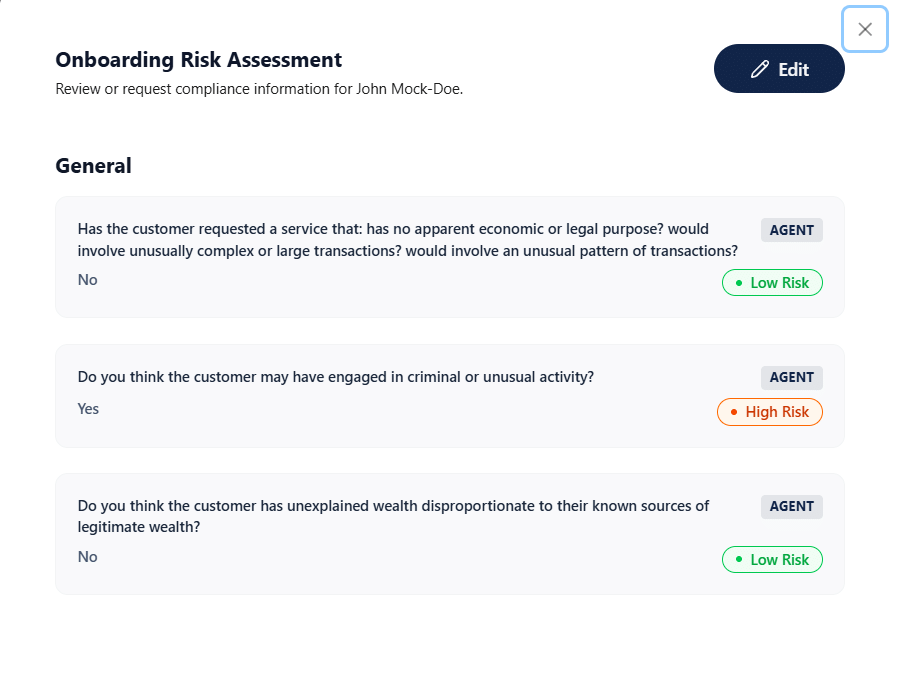
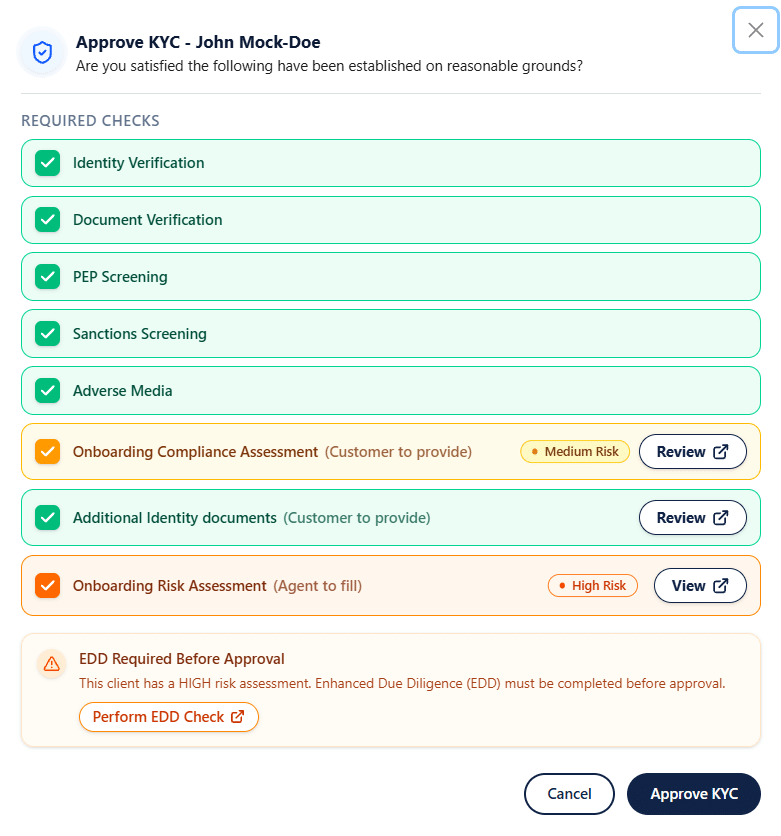
The objective is not to turn KYC into a green tick. It is to give the reviewer enough verified information, risk context and evidence to make a defensible CDD decision.
Initial CDD is only the starting point. The property transaction still has to be managed.
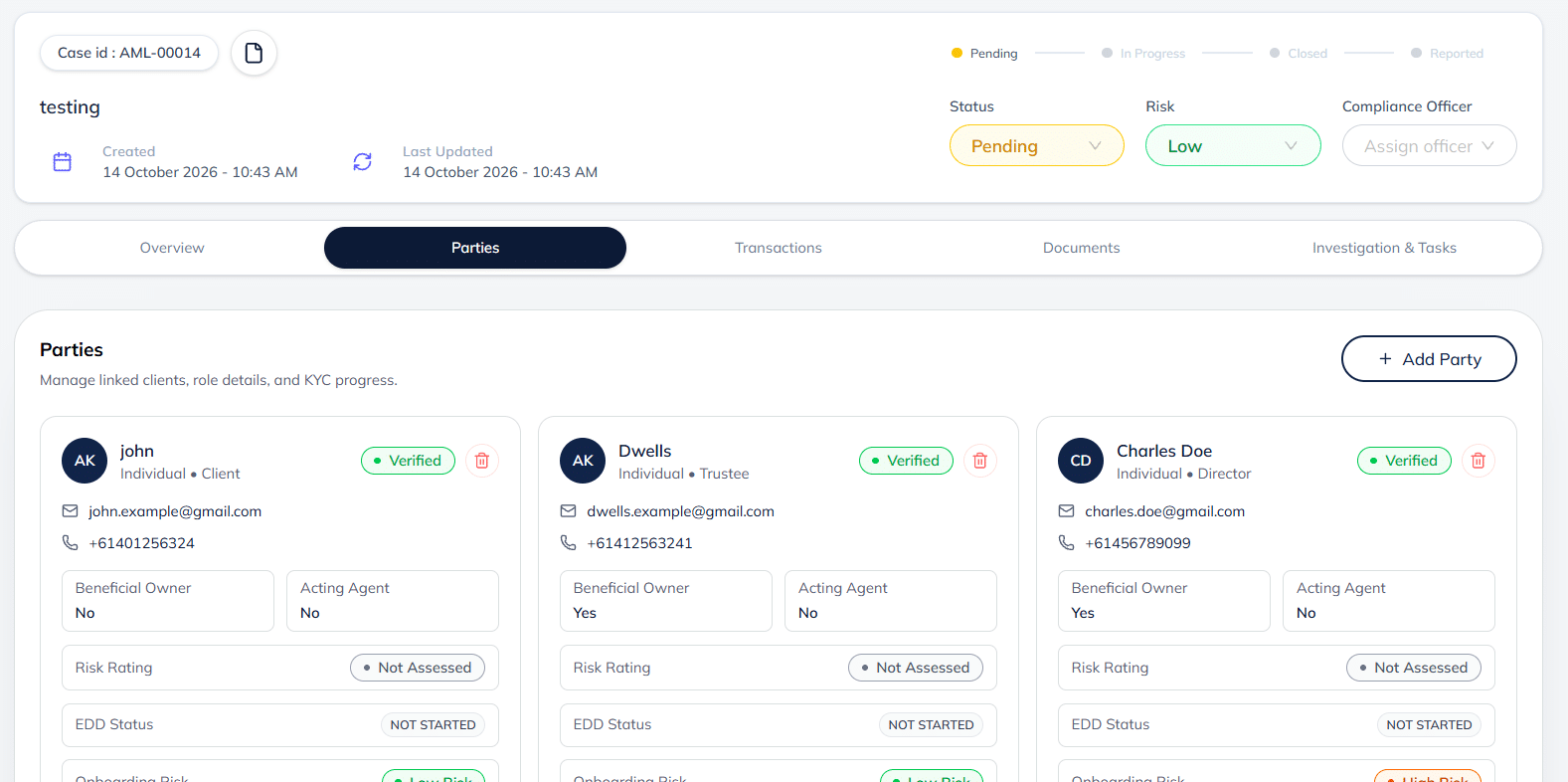
Once the acting party has been onboarded, the agent still needs to manage the other party to the real estate transaction and monitor the customer relationship until it ends. This is where AML Guardian's Property Case Management and Transaction Monitoring capabilities become important.
For real estate, the other side of the transaction matters too.
For the real estate brokering designated service, AUSTRAC states that both the buyer and seller are customers. This means a seller's agent has AML/CTF obligations relating to the buyer as well as the seller, and a buyer's agent has obligations relating to the seller as well as the buyer.
In defined circumstances, Initial CDD on the party you are not acting for can be delayed. AUSTRAC's current guidance sets the outer timeframe as 28 days after exchange of contracts or at least 3 days before the initially agreed settlement date, whichever occurs first. Delayed CDD is not automatic: the statutory conditions and your AML/CTF policies must be satisfied.
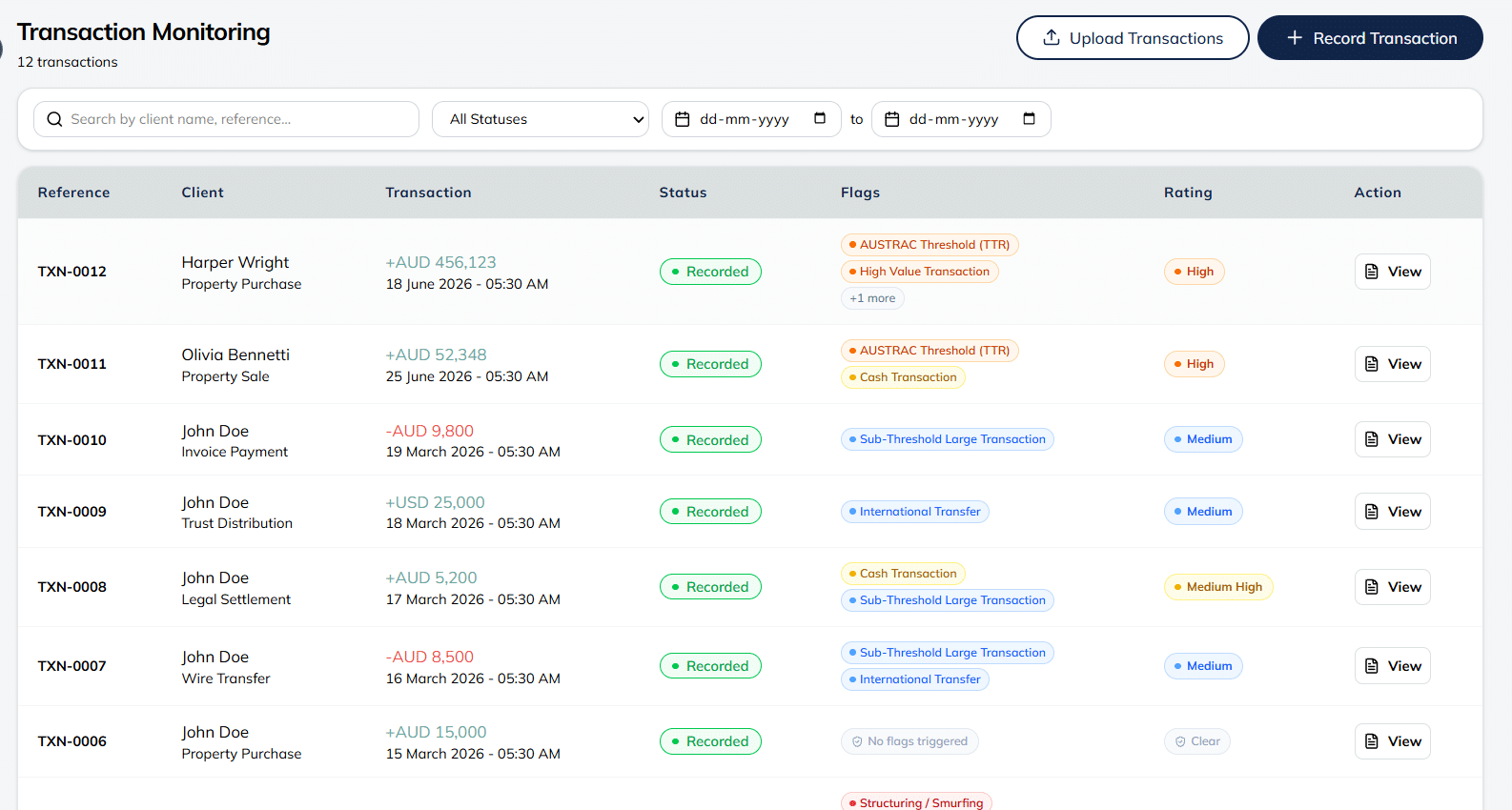
Monitor transactions and behaviour until the relationship ends.
AUSTRAC requires reporting entities to monitor customers while providing designated services. Monitoring should be capable of identifying unusual transactions or behaviours, changes in ML/TF risk and information that may require further CDD, escalation or an SMR assessment.
In AML Guardian, the property or service case can act as the operational record for the matter. Teams can use case management together with transaction monitoring to connect the customer, counterparty, transactions, documents, investigations and follow-up tasks.
From listing agreement or buyer engagement to settlement
Identify the designated service, customer type and who the agency is acting for. Start Initial CDD before providing the acting party with the designated service, unless a lawful delayed CDD provision applies.
Collect onboarding information, verify identity/entity information, assess PEP/sanctions and risk information, complete the agent-side risk assessment and record the onboarding decision.
Record the property or transaction, case details and relevant case risk. Link the verified customer to the matter.
Capture both sides of the transaction, including whether a person is acting as an agent or is a relevant beneficial owner. Initiate or request the appropriate verification evidence.
Review transactions, funding/payment information, changing behaviour, new parties, unusual requests, documents and other trigger events against your AML/CTF Program.
Where a red flag or higher-risk trigger is identified, apply the controls in the AML/CTF Program. This may include Enhanced CDD, source of funds/source of wealth enquiries, Compliance Officer review, investigation or an SMR assessment.
When the designated service and business relationship end, close the case appropriately and retain the CDD, case, transaction and decision records for the applicable retention period.
Move the process into your day-to-day system — without losing the AUSTRAC logic.
AUSTRAC's starter kit is designed to help smaller reporting entities build and operate their AML/CTF Program. AUSTRAC also contemplates businesses integrating the forms and controls into their existing systems and processes. AML Guardian is designed to operationalise those activities in a connected workflow.
| CDD activity | Manual / starter-kit approach | AML Guardian workflow |
|---|---|---|
| Customer onboarding | Onboarding form and separate customer file | Customer record + onboarding compliance assessment |
| Identity / entity verification | Manual copies or separate verification provider | KYC/KYB workflow linked to the customer |
| AML screening | Separate PEP, sanctions and research evidence | Screening results linked to the customer risk profile |
| Customer risk | Risk form or spreadsheet | Customer + staff-side onboarding risk assessment |
| CDD approval | Email / paper sign-off | CDD checklist and recorded approval decision |
| Counterparty | Separate request, emails and uploaded documents | Counterparty captured in the Property Case with verification status |
| Ongoing monitoring | Staff memory, inbox and file notes | Case transactions, red flags, investigations, tasks and monitoring records |
| Evidence | Multiple folders and systems | Customer, case, screening, documents, decisions and audit trail connected |
When risk changes, your controls should change too.
During onboarding or the property transaction, new information can change the customer's ML/TF risk. Your AML/CTF Program should define the triggers and controls that apply.
Depending on the circumstances, this may require Enhanced CDD, further verification, source of funds or source of wealth enquiries, closer monitoring, Compliance Officer escalation or senior manager approval.
Examples of issues to watch for
Be able to show what happened — not just that a check was run.
A strong compliance record should allow a reviewer to reconstruct the decision: who the customer and counterparty were, what was verified, what risk was identified, what happened during the transaction, what was escalated, and why the business decided to proceed.
Customer evidence
KYC/KYB details, identity documents, onboarding responses, screening outcomes, risk assessments, approval and review status.
Matter evidence
Property/service case details, parties, roles, counterparty verification, transactions, supporting documents, investigations, notes and tasks.
Decision evidence
Escalations, EDD, Compliance Officer decisions, regulatory reporting records where applicable, review history and audit logs.
From customer onboarding to settlement — keep the AML/CTF workflow connected.
Identity verification, AML screening, Initial CDD, customer risk, counterparty verification, property case management, transaction monitoring, investigations, reporting and evidence — in one platform.